Six tests. Six different clinical questions.
Not every gut investigation calls for the same tool. The most useful microbiome result is the one that answers the actual question you have about the patient in front of you, and that question keeps shifting.
Some days you're screening someone for the first time. Other days you're chasing an organism that keeps slipping through, confirming a treatment plan, or watching how a child's gut is developing. The technology behind a panel matters every bit as much as the markers it reports, because the method decides what you can see, how confidently you can act on it, and how well the answer fits your patient.
We run six microbiome panels across our GI testing menu, each built on a different technology: shotgun metagenomic sequencing, targeted qPCR, and culture with sensitivity. Each one suits a different clinical decision. We've framed every panel below around the question it answers best, so you can start with the patient and work toward the right test instead of the other way around.
At a Glance: Comparing the Panels
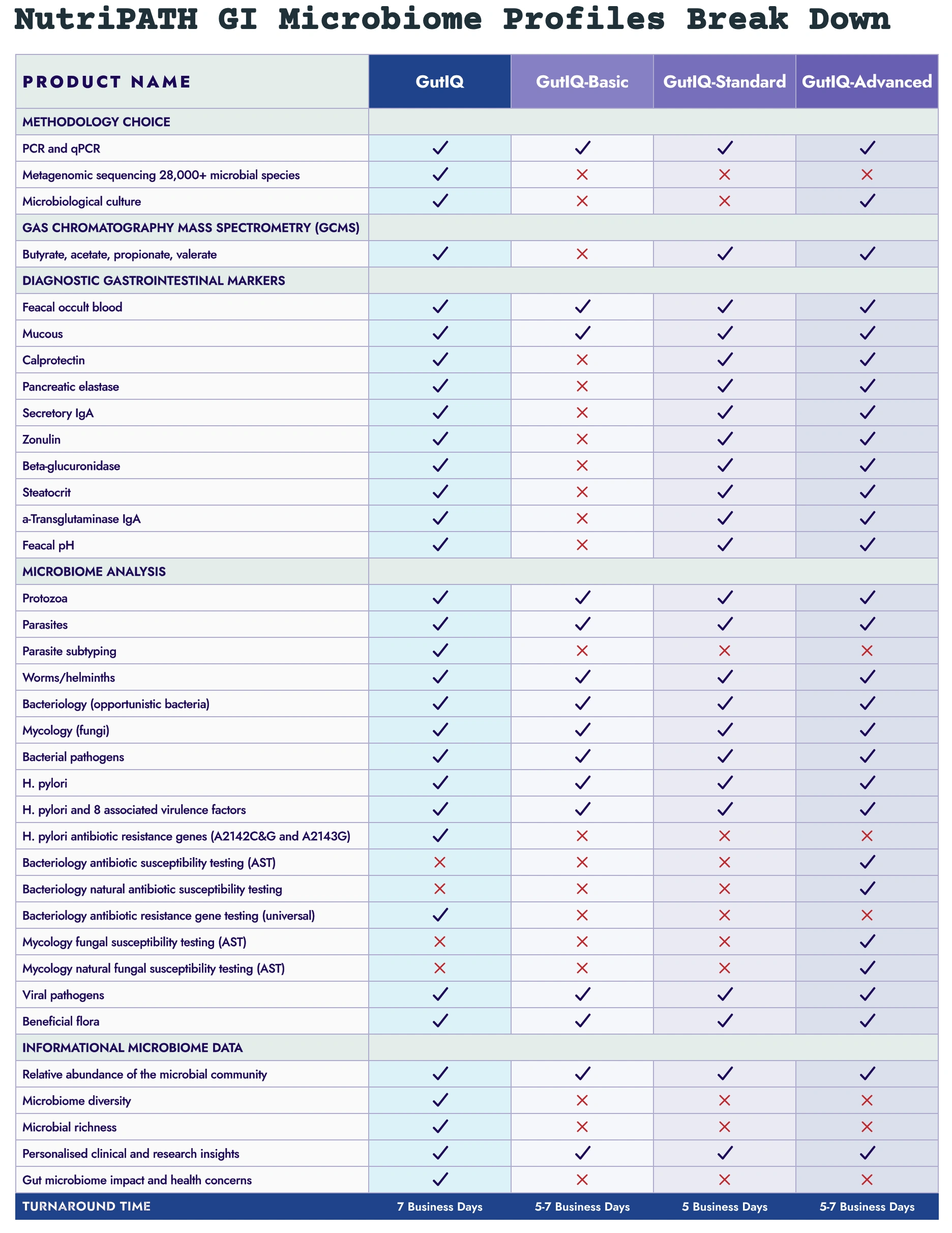
Use this quick comparison to match a test to the question in front of you. (It's a working draft and can be refined against the internal test comparison document once that's available.)
|
Test
|
Core technology
|
Clinical question
|
Turnaround
|
Typical use
|
|
GutIQ - Metagenomic Mapping
|
Shotgun metagenomics (28,000+ species) plus GI functional markers
|
What is the FULL diversity, including unknown or unculturable organisms?
|
7 business days
|
Deepest discovery-level investigation
|
|
GI-Standard
(formerly Complete Microbiome Mapping)
|
qPCR (targeted) plus GI functional markers
|
Which known disease-causing or balance-disrupting microbes are present?
|
7 business days
|
Everyday comprehensive screen (most popular)
|
|
GI-Advanced
(formerly Advanced Microbiome)
|
qPCR plus confirmatory culture & sensitivity (parallel)
|
Which microbes are present, and how do they respond to treatment?
|
5-7 business days
|
When you need a confirmed, ready-to-prescribe roadmap
|
|
GI-Basic
(formerly Microbiome Review)
|
qPCR only (no functional GI markers)
|
What does the qPCR look like on follow-up or re-test?
|
5-7 business days
|
Cost-effective retest after Complete Mapping
|
|
Paediatric Biome GutIQ
|
Shotgun metagenomics plus functional and biochemical markers, paediatric ranges
|
How is this child's microbiome supporting digestion, immunity and gut barrier function?
|
7 business days
|
Children aged 3 to 17
|
|
Baby Biome GutIQ
|
Composition and function vs. age-specific developmental ranges
|
Is this infant's developing microbiome maturing appropriately?
|
7 business days
|
Infants and toddlers aged
0 to 3
|
Every panel turns around in 7 to 10 days. Please confirm markers, inclusions and pricing against the current product pages.
GutIQ - Metagenomic Mapping
→ https://nutripath.com.au/product/shotgun-metagenomics-microbiomix-2212/
“What is the full diversity of the microbiome, including unknown or unculturable organisms?”
When you want the deepest possible view, GutIQ uses shotgun metagenomic sequencing to read all of the genetic material in a stool sample rather than a pre-chosen list of targets. Bacteria, viruses, fungi, parasites and archaea are identified together, including the organisms that won't grow in culture and the ones you weren't even looking for.
What really sets it apart is how deep the analysis goes.
- 40,000+ species screened. Instead of reporting a fixed handful of organisms, the GutIQ maps a huge sweep of the microbial community right down to species level performing an average of 18 million runs for deep insights.
- A genuine deep dive into individual species. The sequencing resolves to the species (and often strain-level) level, so it surfaces organisms that targeted methods never test for.
- H. pylori virulence factors. It goes well past a simple “present or absent” call and characterises virulence markers, which gives you a much more meaningful read on risk.
- Built on one of Australia's largest GI databases. Results are interpreted against an extensive, locally relevant dataset, so what comes back is more accurate and more relevant to your patients.
- Functional insight, not just a species list. Alongside the microbial map, you get biochemical markers covering digestion, inflammation, intestinal permeability and more.
- qPCR technology detects and quantifies the DNA of specific bacteria, viruses, parasites and fungi with high sensitivity and accuracy.
- Confirmatory culture & sensitivity testing grows live microorganisms from the sample and tests how they actually respond to antimicrobial agents.
Best for: complex, unexplained or treatment-resistant cases where you want maximum discovery power and can't afford to miss the one organism a targeted panel would never have searched for. Results in 7 to 10 days.
GI-Standard
→ https://nutripath.com.au/product/complete-microbiome-mapping-2206/
“Which disease-causing or balance-disrupting microbes are present, and how do I treat them?”
GI-Standard uses quantitative PCR (qPCR), a targeted molecular technique that detects and quantifies the DNA of specific, pre-selected microorganisms and genes. Because you choose the targets in advance, qPCR gives you highly sensitive, accurate measurement of the known microbes that matter most clinically.
It works from a single stool sample and screens a broad collection of microbial targets, including pathogenic bacteria, commensal bacteria, opportunistic pathogens, fungi, viruses and parasites, alongside immune and digestive markers. You end up seeing both who is present and how the gut is functioning, which makes it the everyday workhorse for spotting dysbiosis and known pathogens and pointing you toward a treatment direction.
Best for: first-line, comprehensive screening when you're working with established, known targets. Results in 7 to 10 days.
GI-Advanced
→ https://nutripath.com.au/product/advanced-microbiome-mapping-2211/
“Which microbes are present, AND how do they respond to various treatments?”
GI-Advanced starts with everything in our GI-Standard and then runs two methods side by side, so you don't just identify the problem. You walk away with a plan.
Here's why the confirmatory culture & sensitivity piece changes the conversation. A molecular result tells you an organism's DNA is there. Growing it and challenging it confirms what it is and shows you, directly, what it responds to. Just as importantly, this panel tests sensitivity against both pharmaceutical and natural (nutraceutical) antimicrobial agents, so the natural inhibitors many practitioners reach for first sit right there in the same evidence-based result.
The payoff is a tailored treatment plan without the guesswork. Rather than trialling agents and waiting to see what sticks, you can prescribe against organisms that have already shown they're susceptible in the lab. That also helps you rein in broad-spectrum antibiotic use (and the resistance that tends to follow) while getting better results for the individual. It's a genuine prescribing roadmap.
Best for: cases where targeted, confirmed treatment matters and you want trial and error out of the protocol. Results in 7 to 10 days.
GI-Basic
→ https://nutripath.com.au/product/microbiome-review-profile-test-code-2207/
“What does the qPCR look like on follow-up?”
GI-Basic is built as a follow-up to the GI-Standard (code 2206). It runs the qPCR component without the functional GI markers, and you can add individual markers back whenever you need them.
In practice, it leaves out the functional GI markers the Complete panel carries (Faecal Occult Blood, Calprotectin, Pancreatic Elastase, sIgA, Zonulin, β-glucuronidase and Anti-gliadin IgA), any of which you can add back individually. That makes it a focused, cost-effective way to re-check microbial targets after an intervention and see whether treatment has shifted the picture, without paying for the full functional workup every single time.
Best for: retesting and tracking progress after a Complete Microbiome Mapping. Results in 7 to 10 days.
Paediatric Biome GutIQ (ages 3 to 17)
→ https://nutripath.com.au/product/paediatric-biome/
“How is this child's microbiome supporting digestion, immunity and gut barrier function?”
Paediatric Biome GutIQ pairs shotgun metagenomic sequencing with functional GI and biochemical markers, covering diversity, beneficial bacteria, pathogens, inflammation, digestive capacity, intestinal permeability and short-chain fatty acid (SCFA) production, to show how a child's gut is actually supporting their digestion, immunity and barrier function.
The part that matters most here is the reference ranges. A child's microbiome isn't just a smaller version of an adult's, so every marker is read against paediatric reference ranges rather than adult norms. That's what turns a column of numbers into something you can act on with confidence in a younger patient.
Best for: children and adolescents aged 3 to 17, especially those with digestive complaints, food reactions, altered bowel habits, recurrent infections, microbiome disruption after antibiotics, or signs of dysbiosis and gut inflammation. Results in 7 to 10 days.

Baby Biome Gutiq (ages 0 to 3)
→ https://nutripath.com.au/product/baby-biome/
“Is this infant's developing microbiome maturing appropriately?”
In the first three years of life the microbiome changes faster than at any other point, so a single fixed reference range would tell you almost nothing. Baby Biome looks at microbial composition, functional activity, gut inflammation, digestive function and potential pathogens, then reads every result against age-specific developmental ranges that also factor in delivery mode, feeding, antibiotic exposure and environment.
The standout feature is its 12 distinct reference sets. Instead of holding a two-month-old and a two-year-old to the same baseline, Baby Biome is broken into 12 separate reference sets, one for roughly every three months of life. That level of detail keeps the interpretation relevant to a fast-changing gut, so “normal for age” really does mean normal for this age. You find out whether the infant's microbiome is maturing on track, not just what happens to be in it today.
Because early colonisation shapes immune development, metabolic programming, gut barrier integrity and neuroendocrine signalling, the panel helps you trace the factors behind symptoms like digestive discomfort, immune dysregulation, skin conditions, food sensitivities or changes in bowel habits during this sensitive window.
Best for: infants and toddlers aged 0 to 3, particularly when delivery mode, feeding changes or antibiotic exposure raise questions about how things are developing. Results in 7 to 10 days.
Matching the test to the patient
Six panels, six questions, three technologies. If you want maximum discovery and can't risk missing the unexpected, reach for GutIQ. For everyday comprehensive screening of known targets, GI-Standard is your workhorse. When you need a confirmed, ready-to-prescribe plan, GI-Advanced adds confirmatory culture and sensitivity (including natural inhibitors). Use GI-Basic to keep an eye on progress, and lean on the age-specific Paediatric Biome GutIQ and Baby Biome GutIQ for your youngest patients, where the results are matched to their stage of life.
Explore the full GI testing menu and order any of these panels through the product pages linked in each section above.


 NutriPATH Pathology


 Jacqui Evans, Clinical Nutritionist: Oct 27, 2026, 12:11:38 PM